
The truck is due at 8:00, and at 7:45 your three-year-old is sitting in the middle of the hallway, thrilled by the sudden arrival of forty boxes. Nobody did anything wrong. Moving day was simply not built with small children in mind.
The best way to arrange child care for moving day is to take children out of the work zone. Ask a trusted sitter, relative or friend to look after them away from the home while the crew loads. If that is not possible, put one adult in charge of them in a closed-off room, and tell the movers that children are on site. The rest of this guide shows how to set that up.
Why Moving Day Is Risky for Small Children
A move turns your home into a temporary work site. Doors stand open, heavy items travel through hallways, furniture gets emptied or unscrewed, and a large vehicle sits in the driveway. Adults can manage all of that, but small children cannot, and the people running the move have no spare attention to give.
Furniture is a good example. A 2024 report from the U.S. Consumer Product Safety Commission found that about 17,800 people a year are injured when furniture, TVs and appliances tip over. Children under 18 suffered 44 percent of those injuries, which works out to a child being treated in an emergency department every 53 minutes.
Picture a half-emptied dresser or a bookcase with its anchors removed. A toddler sees a ladder. That is why the single most useful rule for the day is simple: one job per adult. Whoever is watching the children does not also answer the movers’ questions, and whoever directs the move does not also watch the children.
How to Arrange Child Care for Moving Day: Three Workable Options
Most families land on one of three setups. Pick the one that fits your children’s ages and the help you can realistically line up.
Option 1: Children spend the loading hours somewhere else
This is the safest option for babies, toddlers and any child who will not stay put. A grandparent, a close friend or your regular sitter takes the children out of the house early and keeps them busy until the heavy lifting is done. Loading is usually the busiest and most chaotic stretch, so that is the window to protect.
The trade-off is logistics. Plan the drop-off time, the pick-up time and who brings the kids to the new place. Children who spend a long day away can arrive tired and unsettled, so have their bedroom or play space ready first.
Option 2: A sitter stays at the home, in a closed-off room
If nobody can host the children, a sitter can stay with them in one room and take breaks outside, such as a park trip or a lunch run. This works best for preschoolers and school-age kids who enjoy a planned routine. It works poorly if the room sits on the crew’s route, so choose carefully (more on that below).
Option 3: One parent or adult takes the kids, the other runs the move
With no sitter available, split the roles on purpose. One adult is the “kid lead” and stays with the children all day. The other adult is the “move lead” and handles the crew, the walk-through and the paperwork. Agree on this the night before, because the split falls apart when both adults drift back into the work.
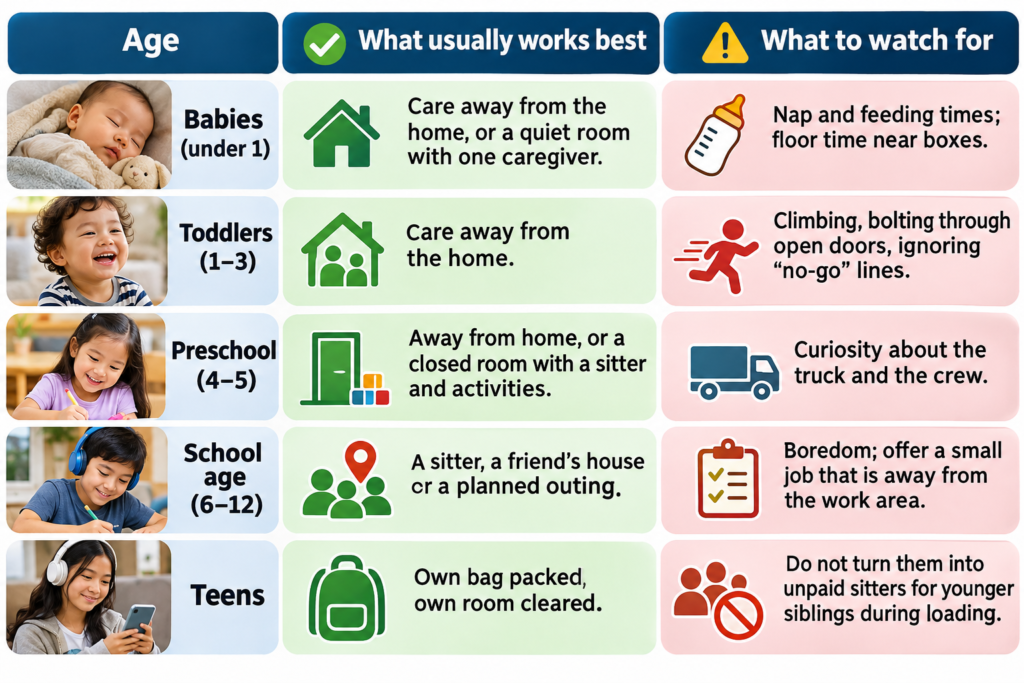
Match the plan to your child’s age
These are general patterns, not rules. Every child is different, so adjust for temperament and for how well they handle change.
How to Find and Brief a Sitter for Moving Day
The short answer: book early, choose someone the child already knows when you can, and put the plan in writing. Moving dates can shift, so ask for a backup person and agree on a buffer in case the truck runs late.
If the sitter has never met your children, arrange a short visit beforehand.
Give the sitter a one-page sheet with these basics:
- Where the children will be, and which room is off limits to the crew
- Allergies, nap times, meal times and anything that calms your child down
- Any medicines, in their original containers, with the dose and time written out
- Your phone number, the second adult’s number and the pediatrician’s number
- The Poison Help line, 1-800-222-1222, which the Health Resources and Services Administration lists for chemical and medicine emergencies
Be clear about the job: watching children. Carrying boxes or guarding the door for the movers is not part of it.
Set Up a Safe Play Room Before the Crew Arrives
One closed-off room gives children a place to be and gives the movers a place not to go. Finish it the night before, so the morning is calm.
- Pick a room off the crew’s route
Ideally it has a door that closes and is close to a bathroom. Pack it last or leave its contents alone until the children leave.
- Make it safe
Anchor tall furniture to the wall or move it out of the room. Tuck away cords, lock windows and remove small objects.
- Move hazards out of reach
Medicines and cleaning products should be stored out of children’s sight and reach, ideally locked up, and kept in their original containers. Packing day tends to scatter both across counters and floors.
- Stock it
Add a few familiar toys, books, snacks, water and a change of clothes.
- Mark the door
A simple sign, such as “Children inside, please knock,” helps a crew that changes shift or sends someone new down the hall.
If a child can open the door on their own, a baby gate or a child-proof door cover adds a layer of protection. Neither one replaces an adult in the room.
What to Pack in a Kids’ Essentials Bag
The kids’ bag stays with the child’s caregiver, never on the truck. It should cover the whole day plus the first night in the new home, because the box with the pajamas will not be the first one you find.
- Snacks and a refillable water bottle
- Two changes of clothes for little ones, plus a spare for accidents
- Diapers, wipes and any creams
- A comfort item, such as a blanket or stuffed animal (never pack it in a box)
- A few quiet activities: books, drawing supplies, or a charged tablet with headphones
- Medicines in original containers, with written instructions
- Pajamas and a toothbrush for the first night
- A card with allergies, the pediatrician’s number and your phone numbers
Let older children pack their own bag from a checklist. It gives them some control.
Keep Children Clear of the Truck and the Driveway
Children should stay away from the truck, the driveway and the loading path, and one adult should be responsible for watching them whenever a vehicle is moving. The risk is real. The Insurance Institute for Highway Safety reports that the National Highway Traffic Safety Administration estimates 263 deaths and about 10,000 injuries a year in backover crashes, based on 2017–21 data. About 39 percent of backover deaths happen in residential spaces such as driveways and the parking areas of apartment and townhouse complexes, and young children and older people are the most likely victims.
A moving day brings extra vehicles, open tailgates and people walking back and forth, so the driveway is busier than usual. Keep younger children indoors or off site, hold hands in shared parking areas, and never let a child stand behind a truck or a car. In an apartment building, apply the same thinking to loading docks, elevators and stairwells.
What to Tell the Moving Crew
Tell the crew before the day, not during it. A short message covers it: how many children will be there (or that they will be away), where the closed room is, which doors to keep shut and who the one point of contact is. The crew is there to move your belongings, so it should not be asked to watch the children.
Most companies ask for access details when you book, which makes that conversation the natural place to mention children. Full Time Movers, a Jersey City-based company that offers local and long-distance moving, packing, loading, unloading and storage, is one example of household movers that asks customers to share access requirements and any final building instructions before the appointment.
At the new home, show the crew the children’s room first so that room gets set up early.
Frequently Asked Questions
Should children be at home during a move?
If you can avoid it, no. Loading is the riskiest and busiest part of the day, with open doors, heavy furniture and a vehicle outside. Care away from the home is the safest choice for babies and toddlers. Older children can stay if an adult is dedicated to them in a closed-off room.
Can the movers watch my kids while they work?
No. A moving crew’s job is to pack, load and unload your belongings, and they cannot do that safely while supervising children. Plan for a separate adult to watch the children for the whole time the crew is working, and tell the crew where the children will be.
Who can I ask to watch my kids on moving day?
Start with relatives, close friends, your regular sitter, or a neighbor your children already know. A familiar person keeps the day calmer for everyone. Ask as soon as your moving date is confirmed, and line up a backup in case plans change or the truck is delayed.
What if I do not have anyone to help with child care?
Split the roles between two adults, with one person caring for the children all day and the other running the move. If you are alone, set up one closed-off room, stock it well, and ask a friend to take over the crew’s questions. Choose a time when the children are usually calm.
How do I keep a toddler safe during a move?
Keep the toddler away from the work area for the full loading window. That means care at another home, or one adult in a closed room with snacks, familiar toys and a gate or door cover if needed. Anchor tall furniture, store medicines and cleaners out of reach, and keep the child away from the driveway.
Make the Plan Before the Boxes Come Out
A calm moving day does not come from a perfect schedule. It comes from deciding, ahead of time, who is looking after the children and where they will be. Settle those two things, and most of the other problems get smaller.
Pick one of the three options this week, write the one-page sheet, and pack the kids’ bag the night before. Then tell the crew where the children are, and let the adults who are moving the furniture focus on the furniture.