
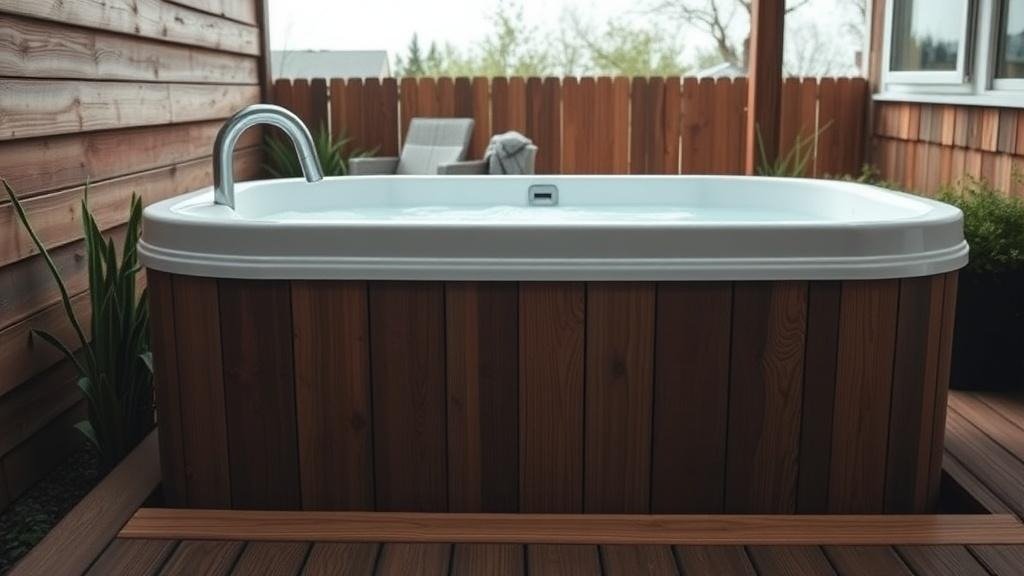
What Nobody Tells You Before Building an Outdoor Sauna is worth evaluating through the homeowner’s real week, not a perfect catalog photo. The best setup is the one that gets used, stays safe, and does not become a maintenance headache.
My neighbor Greg spent last October weekends wrestling a barrel sauna kit onto a gravel pad he’d leveled himself in his backyard in Beaverton, Oregon. The kit assembly went fine. Two guys, a cordless impact driver, a case of Rainier. What almost killed the project was the electrical run. Greg had assumed his detached garage subpanel could handle the 6 kW heater. It couldn’t. He ended up trenching 40 feet back to the main panel, pulling a permit he didn’t know he needed, and paying an electrician $1,600 for what should have been a $900 job if he’d planned it from the start.
Greg’s sauna works beautifully now. He uses it four or five nights a week. His wife, who was skeptical, uses it more than he does. But that project would have gone smoother if someone had told him what I’m about to tell you: an outdoor sauna purchase is half product decision, half site decision. People obsess over the unit and sleepwalk through the pad, the wiring, and the climate considerations. The same kit can be a fantastic buy or a frustrating one depending on what’s underneath it and what’s feeding it power.
Most home builds land between $2,490 and $16,980 depending on size, wood species, and whether you’re adding cold-plunge equipment. Below, I’ll walk through the spec sheet stuff that actually matters, the real installation costs, the research worth knowing about, and the specific moments where you should stop YouTubing and call a professional.
Reading a Spec Sheet Without Getting Played
This is where most buyers get tripped up, because spec sheets for outdoor saunas are designed to impress, not inform.
Here’s the practical short list. Match the heater to the cabin volume. Undersized heaters run constantly and burn out early. Oversized heaters cycle hard and waste electricity. Read the manufacturer’s published sizing chart rather than trusting a forum post from 2019.
Look at the wood and joinery. Pre-cut tongue-and-groove cladding in cedar, hemlock, thermo-aspen, or redwood is standard for a reason: it seals tight and expands predictably. Cheap kits skip the tongue-and-groove for butt joints with felt backing. Those builds leak heat within a season and look rough within two. The $800 you save upfront buys you regret.
For cold-plunge equipment, check chiller horsepower, filtration micron rating, ozone/UV sanitation, and tub material. A 1/3 HP chiller holds 50°F in a small insulated tub in a temperate climate. That same chiller will struggle badly in a hot garage in August.
Door hardware matters more than you’d think. A sauna door swings open hundreds of times a year in extreme temperature gradients. Cheap hinges corrode. Cheap latches warp. This is the kind of detail that separates a $3,000 kit from a $5,000 kit, and it’s worth the difference.
What the Research Actually Says (and Doesn’t)
The most cited sauna study is the Laukkanen 2015 cohort published in JAMA Internal Medicine. Researchers followed 2,315 middle-aged Finnish men for 20 years and found a dose-response relationship between sauna frequency and reduced cardiovascular mortality. Men using a sauna 4 to 7 times per week had roughly half the cardiovascular mortality of those using it once a week. That’s a striking finding, though it comes with the usual cohort-study caveats: these were Finnish men who’d been sauna bathing their whole lives, and healthier people may simply sauna more often.
A 2018 BMC Medicine follow-up from the same research group reported lower dementia incidence at the highest sauna frequencies. The plausible mechanism involves heat acclimation, improved endothelial function, and a heart-rate response that resembles moderate-intensity exercise.
For a home user, 20-minute sessions at 170°F to 195°F, two to four times per week, is a reasonable starting point. Hydrate before and after. Step out if you feel lightheaded. Simple.
I’ll say something slightly opinionated here: the wellness benefits of regular sauna use are, in my view, undersold by the cautious “more research is needed” framing you see everywhere. The Finnish data is remarkably consistent. The mechanistic pathways make physiological sense. And the anecdotal signal from millions of regular users across Scandinavia is hard to wave away. I track my own sleep with a wrist sensor and see deep sleep up roughly 14 percent on sauna days versus off days. That’s one person’s data, not a clinical trial. But it lines up.
See also: Fashion in the Age of Artificial Intelligence
The Boring Truth About Pads, Wiring, and Permits
This is the unsexy section that saves your project.
Pad work comes first. A 4-inch compacted gravel pad with a drainage layer handles most barrel units on flat ground. A 4-inch reinforced concrete slab is the better call for cabin saunas, especially in cold or wet climates. Concrete runs roughly $4 to $7 per square foot installed. A pad that settles or cracks after you’ve placed a 900-pound sauna on it is exponentially more expensive to fix than it was to do right the first time. (Think of it like building a house on a bad foundation, just at a smaller, more irritating scale.)
Electrical is non-negotiable professional territory. A typical traditional sauna heater pulls 4.5 to 9 kW on a dedicated 240V circuit at 30 to 50 amps. This is not weekend-warrior wiring. A licensed electrician should run the circuit, pull the permit, size the breaker, and tie into your main panel. Cutting corners on 240V work is how house fires start. Full stop.
Ventilation is often forgotten. An outdoor sauna needs an intake vent below the heater and an adjustable exhaust on the opposite wall near the ceiling. Skip this and you get stale, stratified air that makes 180°F feel suffocating rather than invigorating.
Permitting varies wildly. Some counties exempt detached structures under 200 square feet from a building permit. The electrical permit for a 240V circuit is almost always required regardless. Call your local building department before you buy the kit. Ten minutes on the phone can save you a code violation and a forced tear-out.
All-In Costs, Not Just Sticker Prices
The sticker price on an outdoor sauna is like the base price on a new truck. It’s real, but it’s not what you’ll spend.
On the sauna side: expect $2,490 for an entry-level barrel kit, $6,000 to $10,000 for a mid-tier cabin with a quality heater, and $12,000 to $16,980 for a panoramic glass-front or premium thermo-aspen build. Now add $400 to $900 for a gravel pad (or $1,200 to $2,400 for concrete), and $600 to $1,800 for the 240V electrical run. Accessories, permits, and first-year maintenance add a few hundred more.
On the cold-plunge side: $4,500 to $7,500 for a residential insulated tub with an integrated chiller, $9,000 to $14,000 for a commercial-grade stainless build with full filtration. Stock-tank DIY setups come in at $400 to $900 but require manual ice, which gets old fast.
Regarding resale value, appraisers don’t add dollar-for-dollar return on a sauna, but a well-built outdoor wellness setup is treated as a selling feature in Northeast and Pacific Northwest markets. It’s not unlike a well-done outdoor kitchen: it won’t appraise for what you spent, but it makes buyers linger.
On the tax side: a residential sauna is rarely HSA or FSA eligible unless a clinician issues a Letter of Medical Necessity for a documented condition. Eligibility is patient-specific. Talk to your tax advisor before banking on reimbursement.
How Outdoor Saunas Compare to Alternatives
An outdoor barrel sauna heats in 25 to 35 minutes and lives on a modest pad. An indoor cabin heats faster but consumes living space and demands proper venting to the outside. An infrared cabin runs at lower temperatures (120°F to 150°F), plugs into a standard outlet, and produces a different physiological response than a traditional sauna. Infrared is easier to install. Traditional is closer to the Finnish protocol that generated the strongest research.
Cold plunges break along similar lines. A purpose-built insulated tub with a 1 HP chiller holds 39°F to 45°F all day, no ice required. A stock-tank conversion can hit the same temps, but you’re buying and hauling bags of ice constantly. A chest-freezer conversion is cheap but lacks filtration and sits in a mechanical gray area that voids warranties and occasionally trips GFCIs at 3 a.m.
The right answer is the build that matches your climate, your space, your install constraints, and the routine you’ll actually maintain three months from now.
For a longer side-by-side reference on models, sizing, wood species, heater wattage, and install considerations, the Sweat Decks complete guide is worth bookmarking before you commit to a kit.
The Three Moments You Need a Professional
First: any time 240V wiring is involved. That covers most traditional sauna heaters and commercial-grade cold-plunge chillers. A licensed electrician pulls the permit, sizes the breaker correctly, and ties into your panel safely.
Second: the pad, particularly in freeze-thaw climates or on soft, recently graded soil. A contractor or experienced hardscaper who understands drainage and compaction will save you from a settling nightmare.
Third: your health. If you have an arrhythmia, uncontrolled hypertension, a recent cardiac event, Raynaud’s phenomenon, are pregnant, or manage any chronic condition, talk to your physician before starting a heat or cold protocol. The Laukkanen data is encouraging for healthy adults, but a 10-minute conversation with your doctor is cheap insurance.
FAQs
Do I need a permit for an outdoor sauna?
Some municipalities exempt detached structures under 200 square feet from a building permit. The electrical permit for a 240V circuit is almost always required. Call your local building department before ordering.
How quickly does an outdoor sauna heat up?
A 6 kW barrel sauna reaches 170°F in 25 to 35 minutes. A 7.5 kW cabin sauna hits that range in 30 to 45 minutes. A cold-plunge chiller pulls a freshly filled tub from tap temperature to 45°F in 3 to 8 hours depending on chiller size and starting water temperature.
How long should a typical session last?
Most adults land between 12 and 20 minutes for a sauna session at 170°F to 195°F, and 2 to 5 minutes for a cold plunge at 40°F to 55°F. Build up gradually if you’re new to either practice.
Can I install an outdoor sauna on a deck?
Some smaller barrel units can sit on reinforced decks if the framing supports the loaded weight, often 600 to 1,200 pounds. Most cabin saunas belong on a ground-level pad. Confirm load capacity with a structural engineer or your contractor before placing any unit on existing decking.
How often does an outdoor sauna need maintenance?
Wipe down benches after each session. Oil the exterior cedar or hemlock once a year. For cold plunges, replace filter cartridges every 6 to 12 weeks, run ozone or UV sanitation on schedule, and drain and refill per the manufacturer’s recommended interval.
Is an outdoor sauna worth the investment?
If you’ll use it three or more times per week, yes. If you’ll use it twice in January and then store towels in it, no. The value proposition depends entirely on whether the routine sticks. That’s why matching the build to your actual lifestyle (climate, schedule, space) matters more than chasing the highest-spec unit.
What’s the best wood for an outdoor sauna?
Western red cedar is the most popular for its natural resistance to moisture and insects, plus it smells great when heated. Thermo-aspen and thermo-spruce are increasingly common in European-style builds and handle temperature cycling well. Hemlock is a solid mid-price option. Avoid untreated pine or spruce unless you enjoy resealing annually.
Disclaimer. This article is general consumer information, not medical advice. Heat and cold therapies carry real cardiovascular load. Anyone with arrhythmias, uncontrolled hypertension, Raynaud’s phenomenon, recent cardiac events, or who is pregnant should consult a physician before starting any new sauna or cold-plunge routine.
Any 240V electrical work should be completed by a licensed electrician under the appropriate local permit.
HSA and FSA reimbursement on wellness equipment is patient-specific and depends on a Letter of Medical Necessity from a clinician. Talk to your tax advisor before assuming a purchase qualifies.
